
By Lura Roti
For South Dakota Soil Health Coalition

South Dakota State University Extension Soils Field Specialist Anthony Bly presented information about soil health practices at the 2022 Soil Health School near Garretson, SD. SD Soil Health Coalition photo.
PIERRE, SD – Cover crops are an increasingly popular land management tool capable of providing a numerous agricultural benefits including improved soil health, weed control, and additional revenue streams for cropland. However, for covers crops – which are grown between cropping seasons – to pay off, producers need to plan them carefully and be aware of any chemicals that have been applied to the field.
Farmers are encouraged to consider a field’s herbicide history before planting cover crops, explained Anthony Bly, South Dakota State University Extension soils field specialist.
“Many herbicides can hang around in the soil for an extended period of time, and based on plant species in a cover crop mix or the purpose of the cover crop, this residual activity could have a negative impact,” Bly explained. “Most plant a cover crop mix that includes a diversity of species – broadleaves, grasses, legumes and brassicas. When you think about it, more than likely, the crop previously planted in that field had herbicide applied to target at least one of those species.”
To maximize stand success and outcomes, before ordering cover crop seed Bly encouraged farmers to consider multiple factors, beginning with the herbicide label.
“First and foremost, the label is your guiding document,” Bly said.
When reviewing the label, farmers should consider:
- Rotation restrictions.
- Duration of residual activity (if any).
- Grazing restrictions if the cover crop is intended for livestock forage.
Consider the purpose
When reviewing an herbicide label, the purpose of a cover crop also needs to be considered, explained Austin Carlson, soil health technician with the South Dakota Soil Health Coalition.
“Herbicide rotation restrictions are designed to be interpreted with cash crops in mind,” Carlson explained. “So, an herbicide’s residual effect that may impact soybean yields, may have less of an impact on stand success of a cover crop mixture that includes turnips and radishes designed to break up soil compaction and speed up water infiltration.”
When Carlson is selecting cover crop seed to plant on his family’s farm following oat harvest, he thinks about herbicide history differently, depending on the purpose.
For example, in one field his father is planting a forage blend that will help extend his grazing season. And because livestock will be consuming the forage, Carlson strictly adheres to the herbicide label’s grazing restrictions. “The label is the law when it comes to grazing restrictions,” Carlson said.
“This cover crop forage fills a sweet spot for us,” Carlson said. “It will be ready to graze about the time we have finished grazing through our pastures. And it will take us through corn harvest, when we can turn the cattle out to graze corn stalks.”
However, in another field about 30 miles southeast from where the family pastures their cow/calf herd, Carlson does not need to consider grazing restrictions because he won’t be grazing livestock in this field. He is planting a cover crop mix in this field to build soil health and help with weed control and nutrient cycling ahead of spring planting.
Test plots demonstrate herbicide interaction with cover crops

This residual herbicide-cover crop interaction trial was conducted at the 2023 Soil Health School near Garretson, SD. SD Soil Health Coalition photo.
Because herbicide labels are designed with cash crops in mind, five years ago the South Dakota Soil Health Coalition began planting an annual field trial to show herbicide interaction with cover crops.
Sprayer boom strips of herbicide are laid down and cover crop species are then planted in rows perpendicular to the strips.
“This allows farmers to see and evaluate the effect of different pre and post emergent herbicides on a variety of cover crop species,” said Carlson, who helps manage the test plots. “We put this together to be a resource for farmers to help them decide what cover crops they can plant based on their herbicide history.”
Each year the data gleaned from the field plots are organized in easy-to-read graphs that list the herbicides and their impact on a variety of warm and cool season cover crop species. Based on farmer feedback and questions, new products are added to the test plots each year.
As he reviews the test plot data amassed over seven seasons, Bly said you don’t need a plant science degree for the results to make sense.
“What continues to surprise me about field plot results, is they do a great job explaining what is already common sense,” Bly said. “If you have a little bit of knowledge of the herbicide compound and what it is designed to kill – this one kills broad leaves, this one kills grasses. This one has a residual, this one does not have a residual – the overall impact on a cover crop mix makes sense.”
DIY herbicide impact test
Many factors like moisture (or lack of moisture) and soil health can impact the amount of herbicide residual remaining in a field. To determine the impact a field’s herbicide history will have on a specific cover crop mix, Carlson said if farmers have some lead time, they can conduct their own in-field test.
Dig up some soil from the field, put it in a bucket and plant a sample of the cover crop mix into the soil. Plant another sample of the cover crop mix into soil that is herbicide free. Water. Wait. Compare the results. “You’re going to see pretty quick which ones are emerging or which ones are emerging but look sickly,” Carlson said.
Carlson also encourages farmers to reach out to him with any questions they may have about herbicide residual activity and its impact on cover crops. Carlson requests that producers send him their questions along with their phone numbers via email to austin@sdsoil.org.
Tour herbicide interaction plots at Soil Health School
Farmers can tour the herbicide interaction test plots during the 2025 Soil Health School held in Huron, September 3-5. To register, visit www.sdsoilhealthcoalition.org.
Results from previous years’ residual herbicide-cover crop interaction plots can be found at https://bit.ly/SDSHCresearch.
Expert tips for cover crop planting
Weed control is important: Start with a clean field, and choose an herbicide with no residual effect, said Anthony Bly, SDSU Extension soils field specialist.
Consider the season: If planting a cover crop late in the growing season, consider the seasonal growing habit of the plant species, explained Austin Carlson, soil health Technician with the South Dakota Soil Health Coalition. “If you are thinking of planting a warm season grass after corn sileage, for example, the season for warm season grasses is nearly over, so I would recommend farmers look at cool season cover crops as we go into fall.”
Don’t let crop residue get in the way of seed-to-soil contact: Harvest the crop ahead of planting a cover crop as high as possible so that there is vertical storage of crop residue and make sure the combine is spreading residue the full width of the header.
“If there is a thick mat of crop residue on the soil surface, I can almost guarantee that the outcome will not be satisfactory,” Bly said. “Apply the same principles and techniques to planting cover crops as you would when planting cash crops.”
No-till drill over aerial seeding: “In our experience, the outcome is better when a no-till drill is used for planting versus aerial seeding because the drill does a good job of seed-to-soil contact,” Carlson explained.
Download a printer-friendly version of this article.
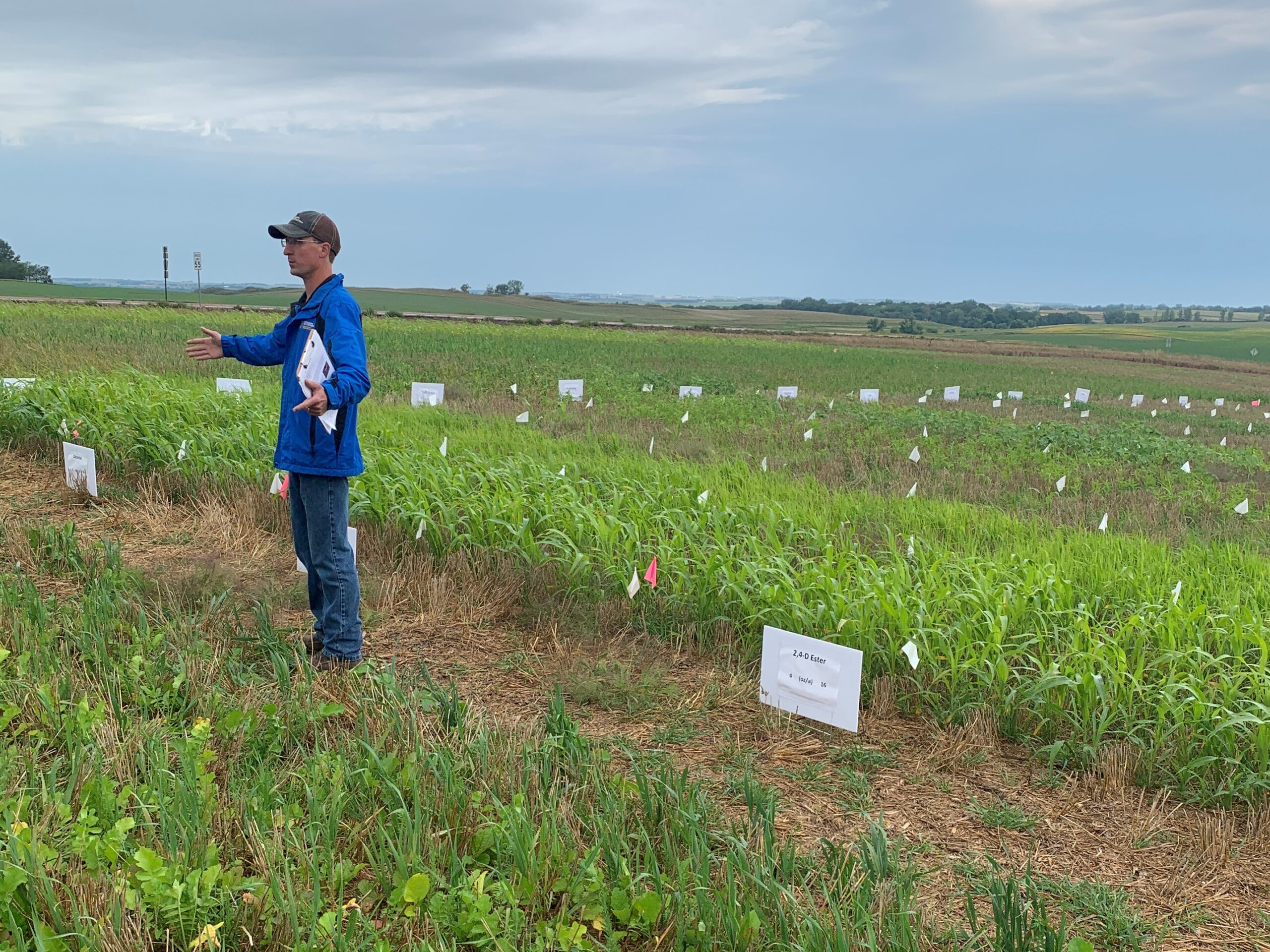
South Dakota Soil Health Coalition Soil Health Technician Austin Carlson explained the residual herbicide-cover crop interaction trials at the 2022 Soil Health School near Garretson, SD. SD Soil Health Coalition photo.
0 Comments