
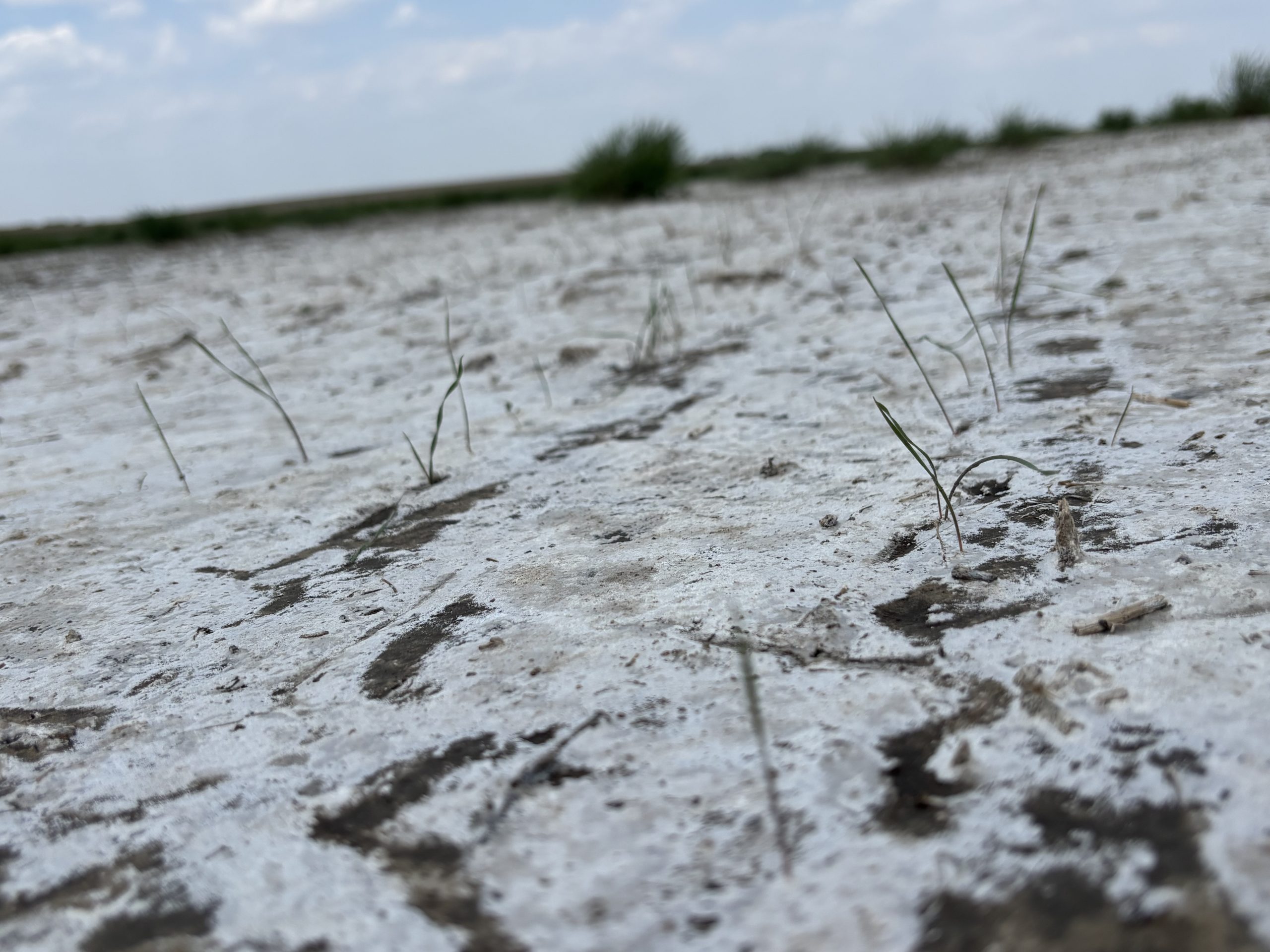
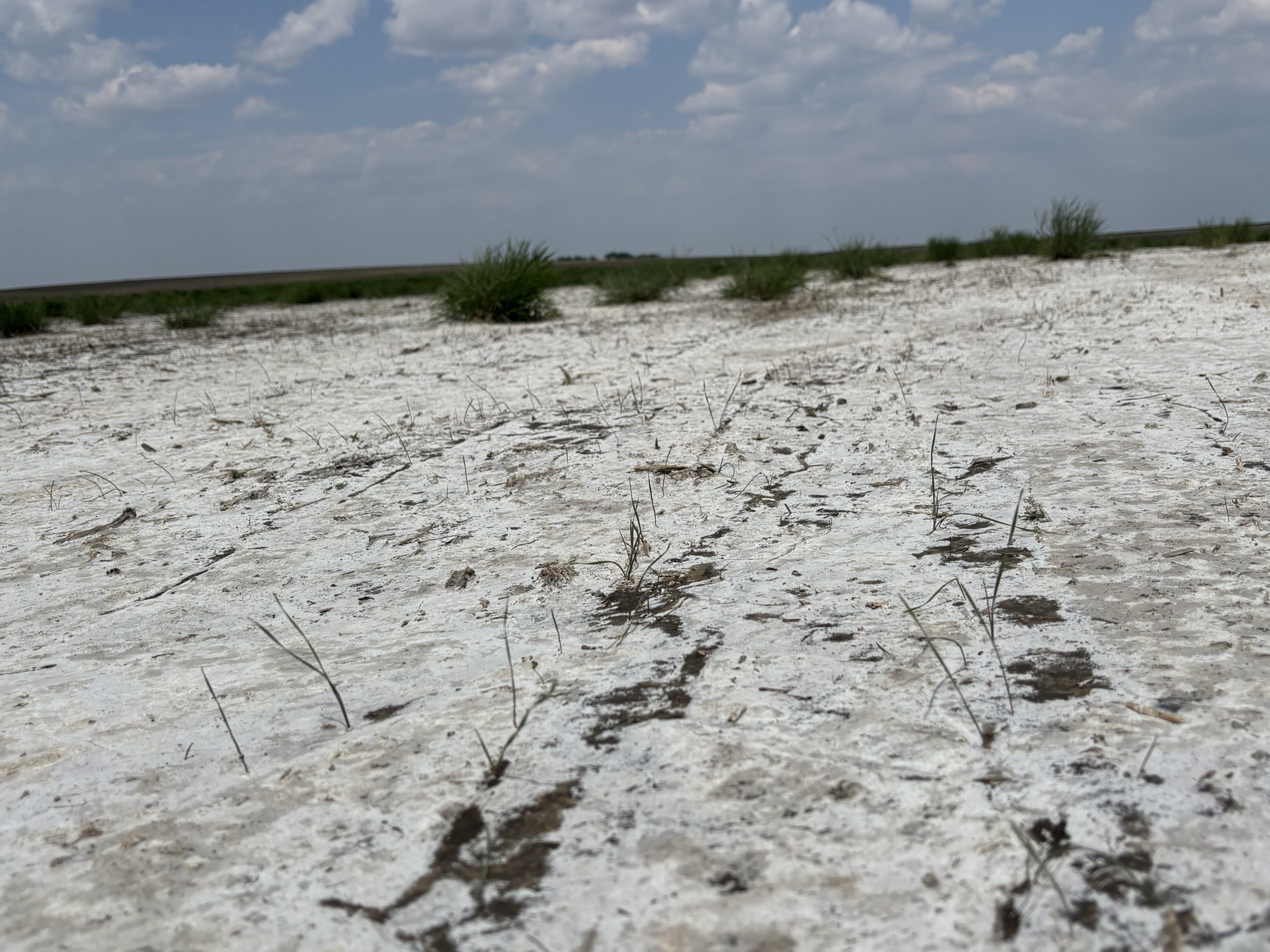
Saline and sodic soils appear white on the surface and restrict the growth of many plants including cash crops like corn and soybeans. Courtesy photo.
By Shauna Kopren
For South Dakota Soil Health Coalition
PIERRE, SD – When you’re driving down the road in July and see land covered in a white substance, that’s not snow. It’s salt.
And it’s a growing problem.
Saline and sodic soils impact millions of acres in South Dakota, with current estimates varying from 7 million acres to as high as 11 million acres. These acres see significant reductions in crop yields, profitability and cropland productivity.
A 2012 report by the Natural Resources Conservation Service indicated that, in Beadle, Brown and Spink counties alone, high soil salt concentrations resulted in an annual economic loss exceeding $26 million.
Efforts to identify and monitor saline areas show the problem is growing at an alarming rate.
Source of the problem
According to Shaina Westhoff, lecturer with South Dakota State University, saline and sodic soils are two unique soil conditions.
“Saline soils have high total salts (calcium, magnesium, sodium, etc.), and sodic soils have a disproportionate amount of sodium on cation exchange sites,” Westhoff said. “Both are detrimental to plant health because many plants cannot utilize water with such high salt content, and they will die of drought stress, or the seed will fail to germinate at planting.”
Regardless of whether soils are saline or sodic, the problem arises the same way.
“This is not solely a geology issue. Rather, management plays a huge role,” South Dakota Soil Health Coalition Executive Director Cindy Zenk said. “Our soils in South Dakota are formed from a salty parent material, and a change in weather patterns is pushing our water table closer to the soil surface. We can’t do anything about that, but we can recognize it and alter our land management practices to minimize the spread of saline acres and perhaps even remediate them.”
Zenk said that certain farming practices like tillage, keeping the soil bare outside of the growing season, and using a monoculture cropping system diminish soil structure. That degradation limits the ability of the soil to infiltrate water. When water stands on the soil surface, it evaporates. That evaporation actually pulls groundwater to the surface through capillary action. As the water rises through the salty parent material, it brings salt to the surface.
“Thankfully there are options to manage these acres, increase your actual production history, and your bottom line,” Zenk said. “However, if we don’t make some changes, these problem areas just grow larger.”
The problems grow on farmers’ balance sheets, as well.
“Neither corn nor soybeans are highly tolerant of salinity or sodicity, and yields will drop significantly, or the crop will fail to germinate,” Westhoff said.
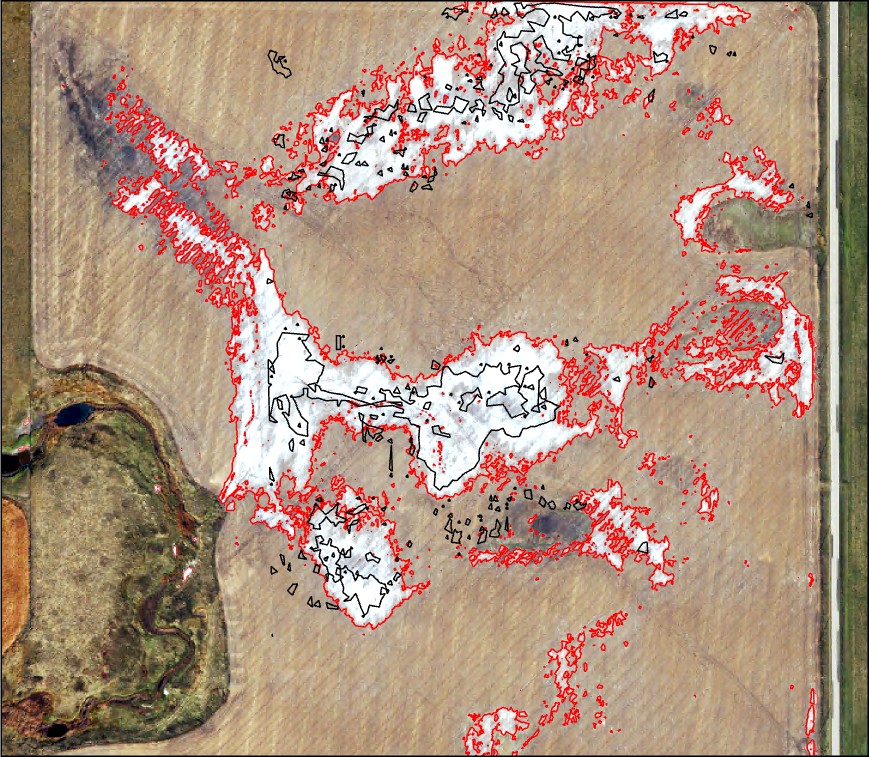
This is a typical quarter of land in eastern South Dakota affected by soil salinity. The outlined areas were generated from Caleb Caton’s ArcPro model to identify saline soils. The black lines outline the boundaries of visible salinity in 2005 imagery (6.0 acres), and the red lines outline visible salinity in 2023 imagery (29.6 acres). The black and red lines are both overlayed onto the 2023 imagery. This image shows a 393 percent increase in salinity/sodicity affected acres on this quarter of land from 2005 to 2023. Courtesy image.
Monitoring the problem
Caleb Caton, agronomist with Ducks Unlimited, has been working on a pilot project that uses a mapping system that identifies and quantifies saline and sodic soils across South Dakota. Caton has worked with many producers who wanted to remedy the saline/sodic soils on their cropland.
“Throughout those years of interactions, producers would all say the same thing: ‘These areas never used to be this big,’” Caton said. “We could compare years of imagery and see the changes visually, but to my knowledge, a tool did not exist that would automatically identify and quantify saline acres.”
That is when Caton thought to utilize ArcPro, a mapping and analysis program, to analyze aerial imagery between 2005 and 2023 to develop an automated process for identifying and quantifying areas affected by salinity/sodicity. These areas stand out easily on color imagery as white areas, and he was able to identify the range of pixel colors in the aerial image color spectrum that are characteristic of the affected saline areas.
“I then created a model within ArcPro that not only identifies and outlines saline acres but quantifies them,” Caton said. “This analysis could be run at a state, regional, county, operation, or field level, to show changes in saline affected acres throughout time.” Caton works with producers who use this information to show the changes in salinity in their own cropland, helping to inform their production procedures.
Innovative solutions
There are multiple remediation methods regarding saline/sodic soils; however, using perennial grasses to move salts downward to the subsoil is proving successful. The success of planting salt tolerant grasses in sodic and saline soils has been documented in both research and practical results.
Scott Hamilton, a cow-calf producer and feedlot operator from Hitchcock, located in east central South Dakota, has had success planting a grass mix which includes a salt-tolerant variety of alfalfa, Garrison creeping foxtail, fescue, reed canary grass and others.
“We started planting this mix in those areas, and in a three-year period of time, we took the areas that were pure white saline and sodic soil and started producing three tons of feed per acre,” Hamilton said. “By seeding those areas, we quit spending money and started harvesting hay, leaving it as a pollinator plot or for cover as hunting, but most importantly, healing the soil and making it more productive.”
Hamilton also noted that by seeding those areas he has seen a reduction in the amount of saline/sodic soil in the rest of the fields. Westhoff said that perennial grasses, even annual weeds like foxtail barley and kochia, on salt acres promote and facilitate better drainage and soil biology. This allows water and salt to move deeper into the soil profile through natural processes, complementing what chemical amendments do alone.
“Even just keeping saline soils covered with residues can help them improve,” Zenk said. “I know of producers who place hay bales in their saline areas and allow livestock to graze the bales. The animals spread the hay over the surface, and that protects the soil and minimizes evaporation. It adds biology back to the soil, and that’s the first step in improving the soil structure.”
Looking to the future
During the process of developing his protocol, Caton learned that a very similar study was conducted and published in 2016 by Dr. Tulsi P. Kharel. Kharel looked at data from 2008 to 2012 that showed a significant increase in the number of eastern South Dakota acres, 1.4 million acres, roughly the size of Cheyeanne River Reservation, that had increased in soil salts.
The available data indicates that soil salinity and sodicity issues continue to increase in South Dakota, and unfortunately the total number of affected acres may be underestimated.
“Some of the strongest scientists we have working on this issue are the producers who farm these soils every season,” Westhoff said. “They’re the people with boots on the ground, seeing how these acres change annually, and are implementing some of the most creative strategies for healing this issue on our landscape.”
For producers like Hamilton, finding creative ways to remediate these soils is worth it.
“What we have done is taken a negative, with all the inputs that we put into our crop farming without any benefit, and turned that into a positive with our grass seeding,” Hamilton said. “But you must change your outlook, shut the sprayer off, and want to do it. Your field is not going to be totally square, and you may have irregular shapes that you are going to work around, but economically and productively, it is a no brainer.”
To learn more about regenerative land management, contact the South Dakota Soil Health Coalition at 605-280-4190 or sdsoilhealth@gmail.com or visit www.sdsoilhealthcoalition.com.
Click here to download a printer-friendly version of this article.
Saline and sodic soils appear white on the surface and restrict the growth of many plants including cash crops like corn and soybeans. Courtesy photo.
0 Comments