
Soil Electrical Conductivity
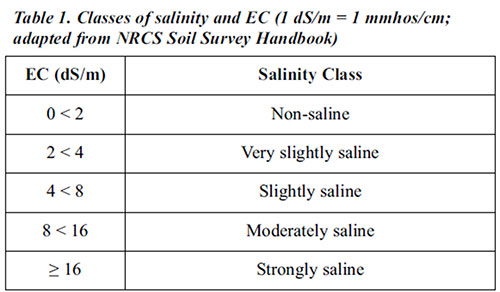 Soil electrical conductivity (EC) measures the ability of soil water to carry electrical current. Electrical conductivity is an electrolytic process that takes place principally through water-filled pores. Cations (Ca2+, Mg2+, K+, Na+, and NH4+) and anions (SO4 2-, Cl-, NO3 -, and HCO3 -) from salts dissolved in soil water carry electrical charges and conduct the electrical current. Consequently, the concentration of ions determines the EC of soils. In agriculture, EC has been used principally as a measure of soil salinity (table 1); however, in non-saline soils, EC can be an estimate of other soil properties, such as soil moisture and soil depth. EC is expressed in deciSiemens per meter (dS/m).
Relationship to Soil Function
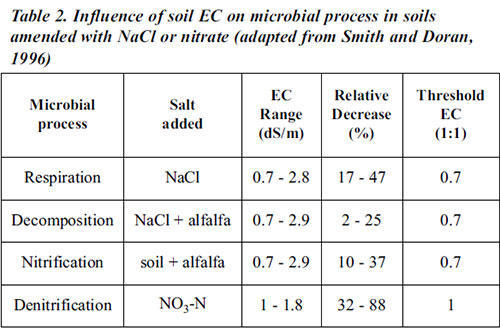 Soil EC does not directly affect plant growth but has been used as an indirect indicator of the amount of nutrients available for plant uptake and salinity levels. EC has been used as a surrogate measure of salt concentration, organic matter, cation-exchange capacity, soil texture, soil thickness, nutrients (e.g., nitrate), water-holding capacity, and drainage conditions. In site-specific management and high-intensity soil surveys, EC is used to partition units of management, differentiate soil types, and predict soil fertility and crop yields. For example, farmers can use EC maps to apply different management strategies (e.g., N fertilizers) to sections of a field that have different types of soil. In some management units, high EC has been associated with high levels of nitrate and other selected soil nutrients (P, K, Ca, Mg, Mn, Zn, and Cu). Most microorganisms are sensitive to salt (high EC). Actinomycetes and fungi are less sensitive than bacteria, except for halophyte (salt-tolerant) bacteria. Microbial processes, including respiration and nitrification, decline as EC increases (table 2).
Problems with Poor Soil EC Levels
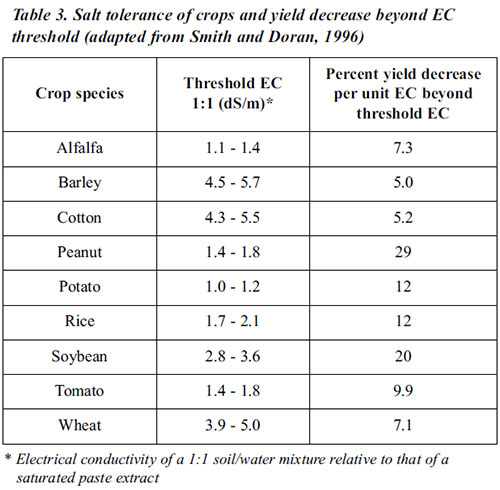 High EC can serve as an indication of salinity (EC > 4 dS/m) problems, which impede crop growth (inability to absorb water even when present) and microbial activity (tables 2 and 3). Soils with high EC resulting from a high concentration of sodium generally have poor structure and drainage, and sodium becomes toxic to plants.
Improving Soil EC
Effective irrigation practices, which wash soluble salts out of soil and beyond the rooting depth, can decrease EC. Excessive irrigation and waterlogging should be avoided since a rising water table may bring soluble salts into the root zone. In arid climates, plant residue and mulch help soils to remain wetter and thus allow seasonal precipitation and irrigation to be more effective in leaching salts from the surface. To avoid the adverse effects of high EC (salinity) in irrigation water, the leaching requirement must be calculated for each crop. Leaching requirement is the fraction of water needed to flush excessive salt below the root zone, that is, the amount of additional water required to maintain a target salinity level. Adding organic matter, such as manure and compost, increases EC by adding cations and anions and improving the water-holding capacity. In some cases, a combination of irrigation and drainage is necessary to lower salt concentration and EC. An EC water (ECw) ≤ 0.75 dS/m is considered good for irrigation water. Beyond this value, leaching or a combination of leaching and drainage will be necessary if the water is used.
This Page Was Created Utilizing Text And Images From These Sources:

Soil Health School
The 2026 Soil Health School is set for September 15-17 near Twin Brooks and Marvin, SD.
Small Scale Ag
Soil Health School
The 2026 Small Scale Ag Soil Health School is set for Aug. 28 in Huron, SD.
News & Events
Test grain for nitrates before using it as forage
By Stan Wise With the vast majority of South Dakota in a drought and experiencing high temperatures, grain producers are having to make some tough decisions about their crops. Will those grains produce enough yield to make harvesting them a financially viable option,...

Darling Creek Ranch Named 2026 SD Leopold Award Winner
Sand County Foundation Dan and Sharon Anderson’s Darling Creek Ranch has been selected as the 2026 South Dakota Leopold Conservation Award® recipient. The $10,000 award honors ranchers, farmers, and forestland owners who go above and beyond in their management of soil...

Building operational resilience with soil health
By Stan Wise South Dakota Soil Health Coalition PIERRE, SD – Resilience. It’s one of the prizes that keeps conservation-minded land managers striving for improved soil health. Operational resilience in the face of floods, market fluctuations, rising input costs,...